CIRCLE & KEYPrivate Travel Atelier
← Middle East

Circle & Key presents

The River Remembers

An Eight-Day Passage Along the Nile

8 Days · 7 Nights · Cairo · 2 nights → Aswan · 1 night → Abu Simbel · 1 night → Luxor · 3 nights

The Preface

The desert preserves what the river creates. The people carry the rest.

Egypt does not belong to history. It belongs to the measure of time itself.

For five millennia the narrow green ribbon of the Nile has cut through absolute silence. On either bank the limestone and granite remain intact not because they were protected, but because the desert air refused to destroy them.

The usual way through Egypt is fast, crowded and strangely silent about the living. We do not travel this way. We enter the temples once the gates have closed, cross the river before dawn, and descend into chambers that remain locked to the public.

And we sit with the people whose lives are bound to the stone: the conservator with pigment under her fingernails, the excavation director who will not yet publish what he has found, the carver who is the last of four generations, the family on Elephantine who have kept their language in song.

Some parts of this journey have deliberately been left out.

Day 01 · Cairo

The Edge of the Plateau

Cairo, Egypt

“Before the dynasties, the limestone.”

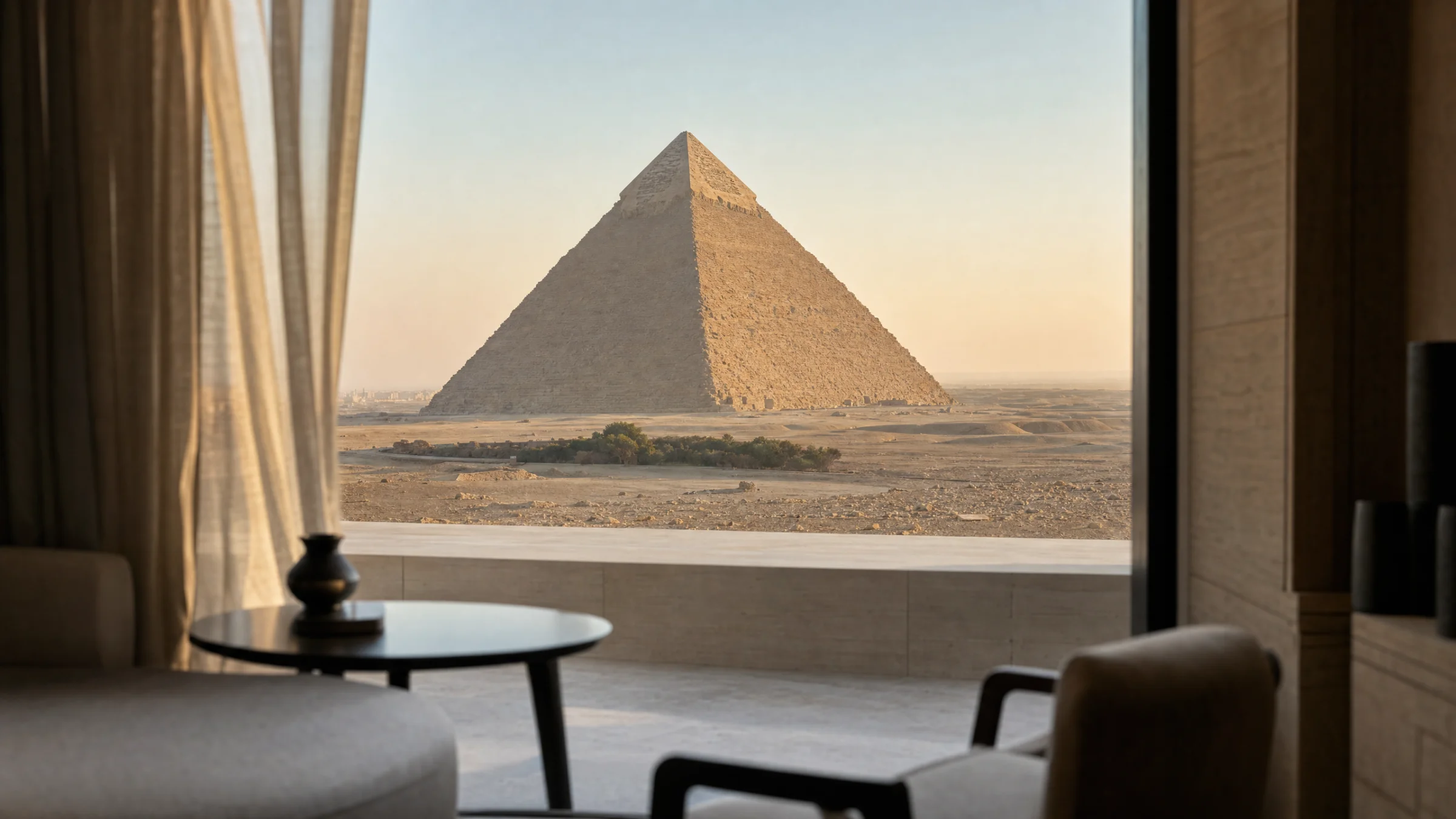
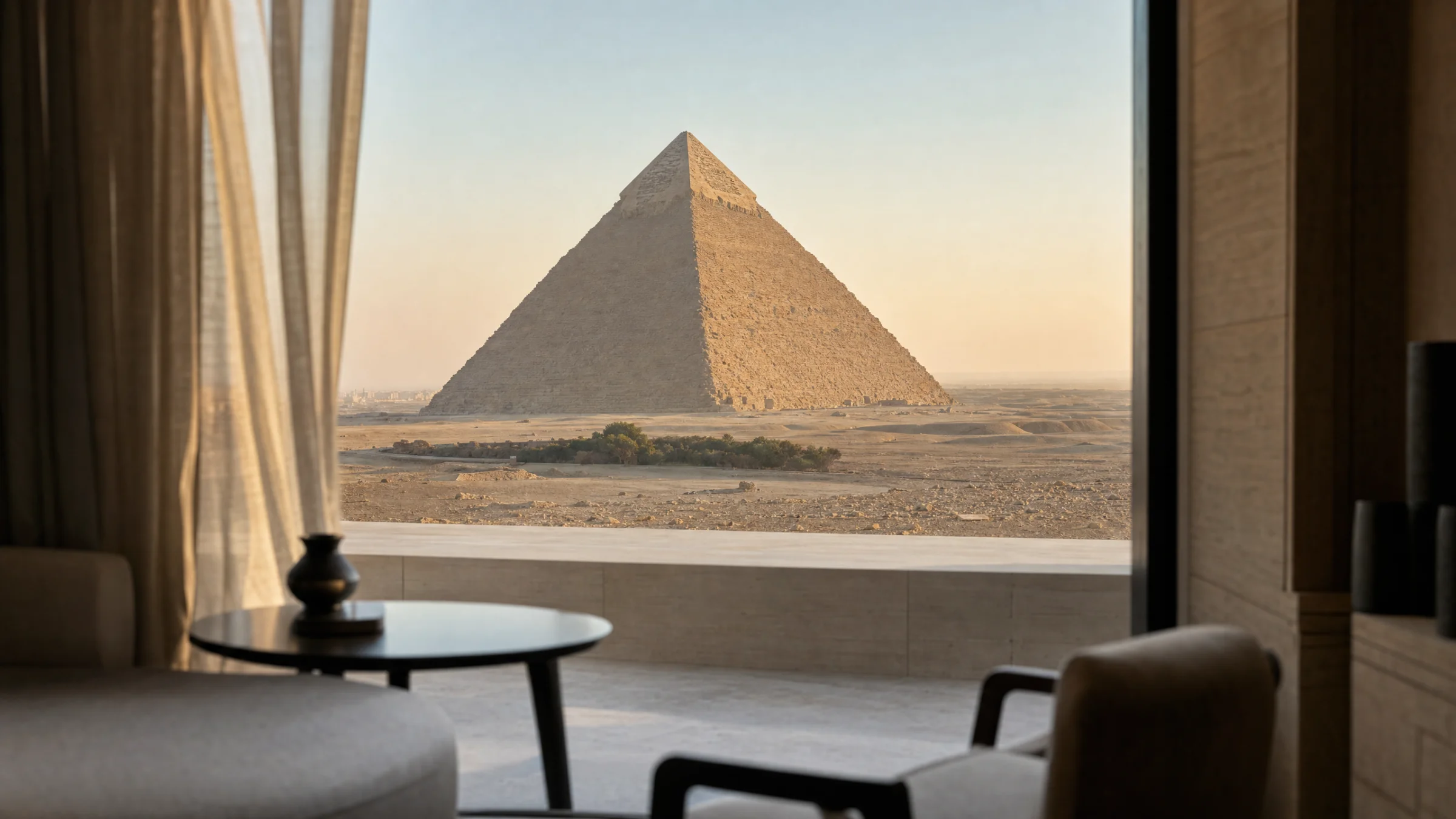
Arrive in Cairo and move west away from the river, where the density of the city gives way without warning to open desert. There is no program waiting for you today. Your address is the Marriott Mena House. Settle in. Outside the gardens Cairo keeps its unrelenting tempo; inside, the afternoon stands still.

As the heat breaks, step onto the terrace. The pyramids rise directly from the plateau against the falling amber light.

You are joined for a drink — briefly, without ceremony — by the Egyptologist who will travel with you for the whole of the week. Not a guide. A scholar with a permit and a dig season, who has spent twenty years arguing about the same few hundred metres of limestone. She will not lecture tonight. She only wants to know what you already believe about Egypt, so she knows where to begin.

Dinner is served quietly overlooking the desert. Tomorrow, the story begins.

The Company

One scholar, the entire passage — the same voice from the plateau to the Theban hills, so the argument can develop rather than restart each morning.

Tonight · Marriott Mena House
Day 02 · Cairo

Limestone and Iron

Giza & the Grand Egyptian Museum

“The desert does not fade into the valley; it stops at a single line of green.”

The flight lifts over the plateau early, before the heat begins to rise from the stone. From above, the whole logic of Egypt resolves in a single glance: a razor boundary where the green silt of the floodplain ends and the desert begins without hesitation.

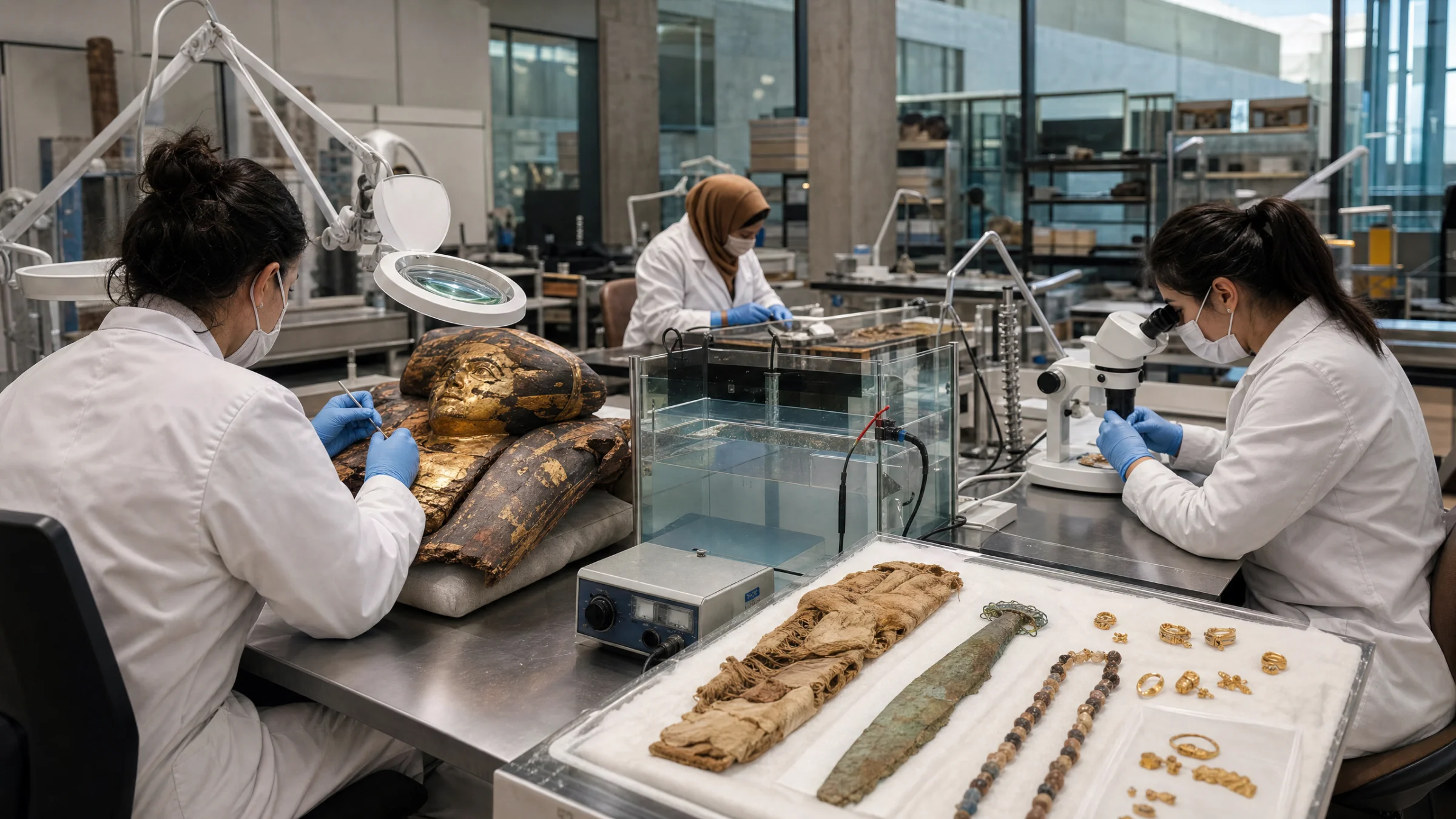
By midday we enter the Grand Egyptian Museum — not through the atrium, but through the conservation laboratories. The chief conservator meets you at the bench where she works. New Kingdom pigment, linen, gilded cedar. She will show you a joint she has been unable to stabilise for two years and explain, without embarrassment, why she may lose it.

Then the galleries, and the full funerary treasure of Tutankhamun gathered in one continuous sequence.

The late afternoon returns you to the gardens of Mena House. Shade, cold water, long shadows across the terrace.

In the evening, a private table with one of the senior Egyptologists of her generation — a career spent in the field and in the archives. She will speak about how the discipline itself was built: which discoveries were recorded honestly and which were dressed up for their patrons, how much of what the world believes about ancient Egypt was decided by nineteenth-century Europeans in a hurry, and how much of it her own generation has had to undo. She is not neutral about her field. By the end of the evening, neither are you.

The Conservation Suites & the Private Table

The museum's working laboratories away from the public floors, and afterwards an unhurried evening with a senior Egyptologist on how the study of ancient Egypt was assembled — and what it got wrong.

Tonight · Marriott Mena House
Day 03 · Aswan

The Granite Gates

Aswan & Lake Nasser

“Where the river enters Egypt through stone.”

A morning flight south brings you to the first cataract, where the Nile narrows between mounds of polished black granite and the pace of the river changes. Cross by wooden launch to the west bank. The seventh-century Monastery of St. Simeon stands wind-scoured against the ridge; the rock-cut Tombs of the Nobles look out across the valley.

In the afternoon you are received on Elephantine Island, in a Nubian house that has stood in the same family for four generations. Tea, then bread, then a long afternoon of talk.

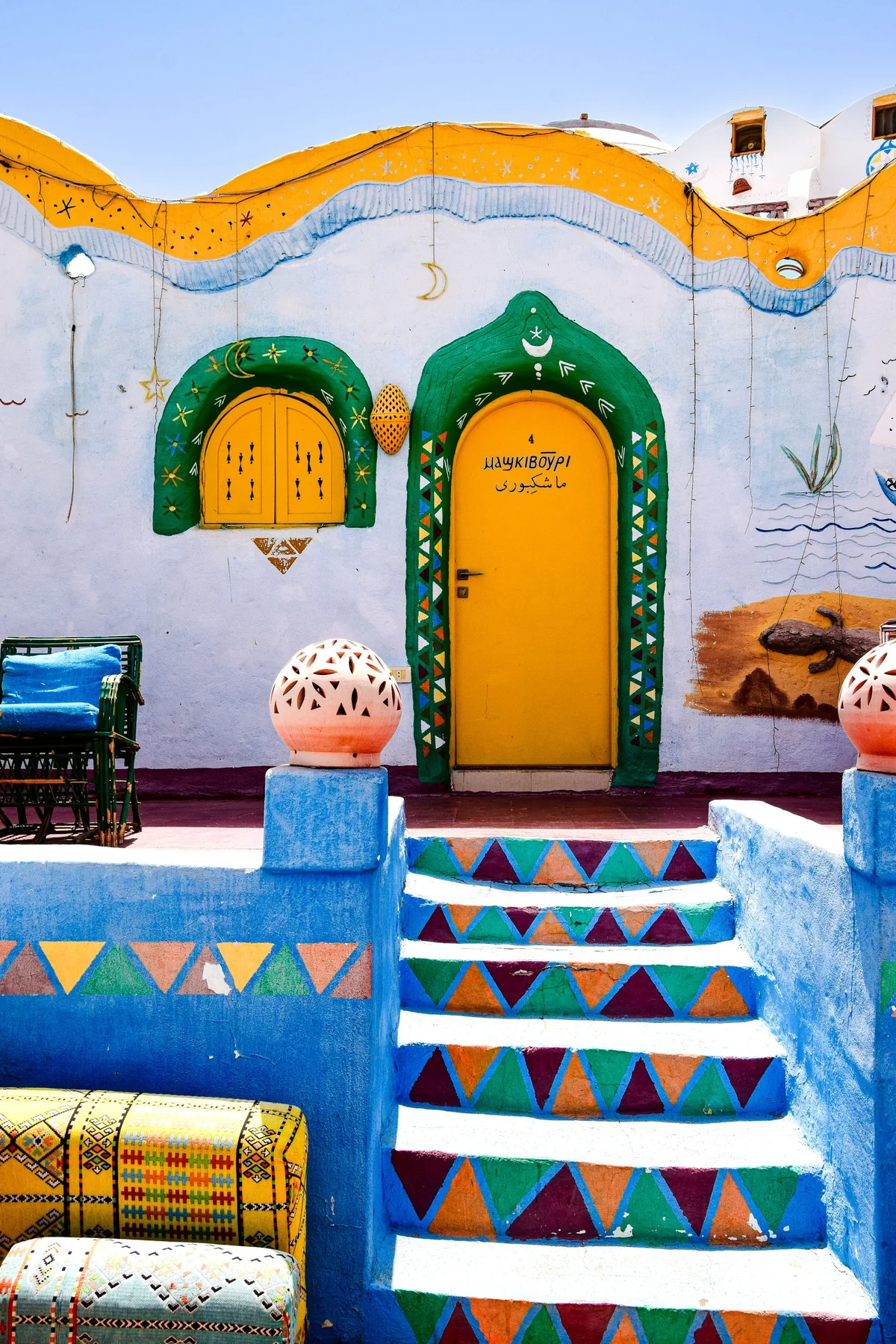
Nubia is older than Egypt's dynasties and has its own language, its own music and its own architecture — blue and ochre walls, domed rooms built for heat. The grandmother sings what she was taught as a girl. The grandson admits he understands the words but could not write them. What is carried forward in a family, and by whom, is the conversation of the afternoon; there is no tidy answer to it, and nobody in the room pretends otherwise.

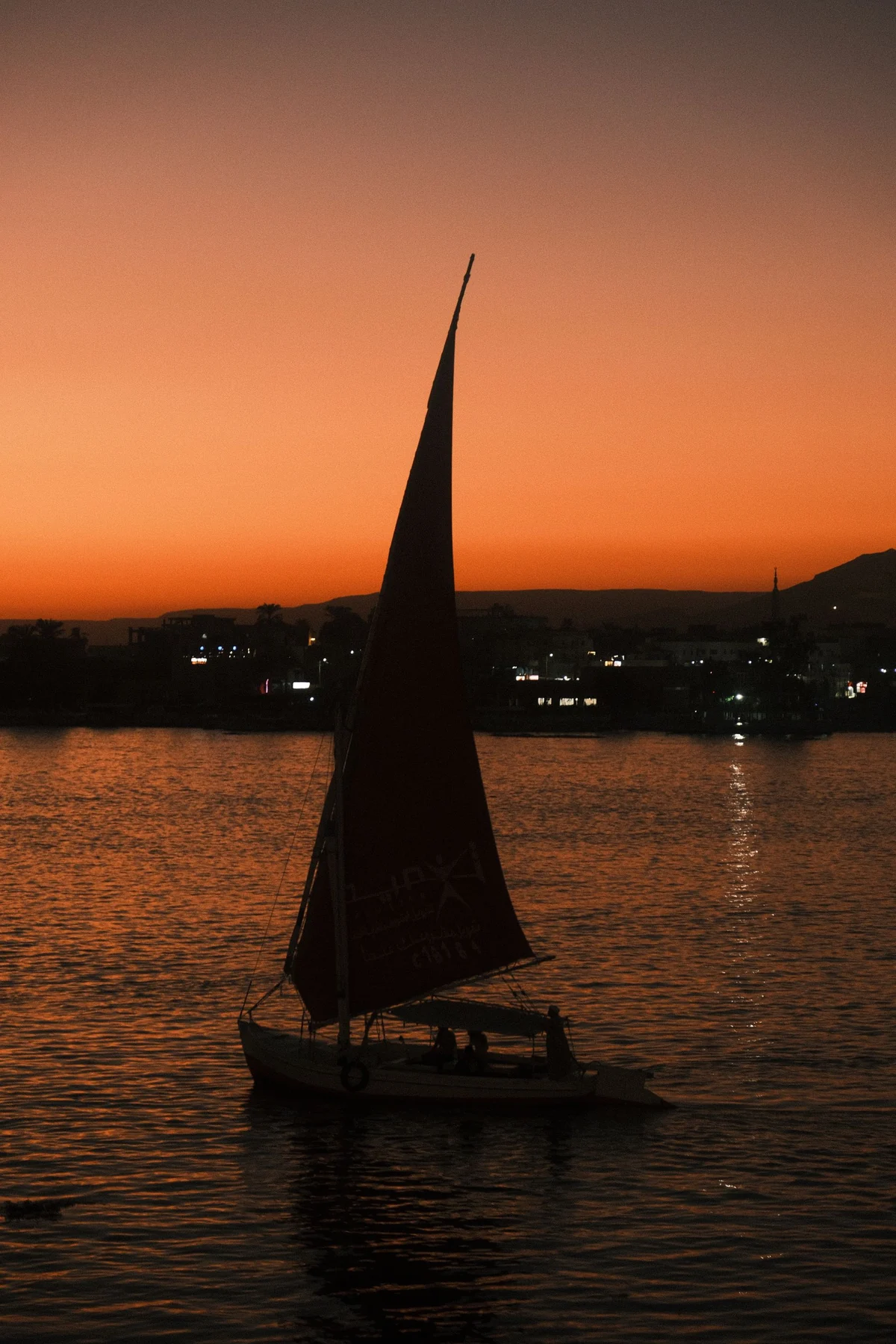
Late afternoon belongs to the terrace. A drink as the white sails catch the evening wind, before the river falls completely dark.

The Experience · Kalabsha After Dark

After nightfall the island of Kalabsha is kept open for you: dinner among the sandstone colonnades above Lake Nasser, candlelit, with no one else on the island.

Tonight · Sofitel Legend Old Cataract Aswan

A vividly painted Nubian house in Aswan, echoing the family home and living traditions described in the chapter

Day 04 · Philae & Abu Simbel

The Southern Reach

Philae & Abu Simbel

“Some stones are understood only once the light begins to fail.”

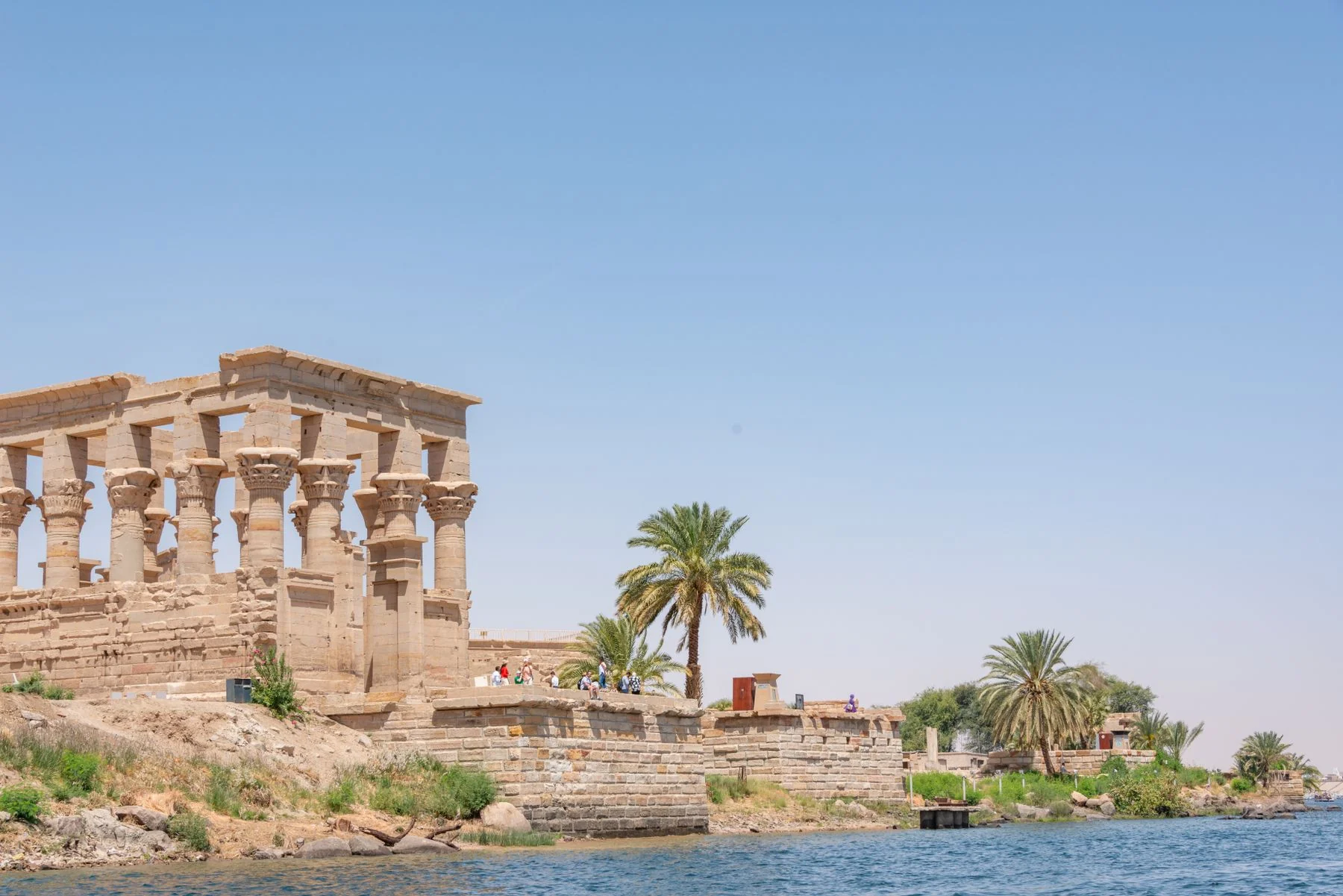
The water is still before the morning launches begin. Cross to the island of Agilkia, where the temple of Isis was reassembled stone by stone to outrun the rising Nile. In the early shadow the relief carvings hold a quiet that disappears before noon.

A short flight south cuts across the desert into Nubia and comes down beside the expanse of Lake Nasser. The midday heat is left to the stone outside. Rest, read, watch the water.

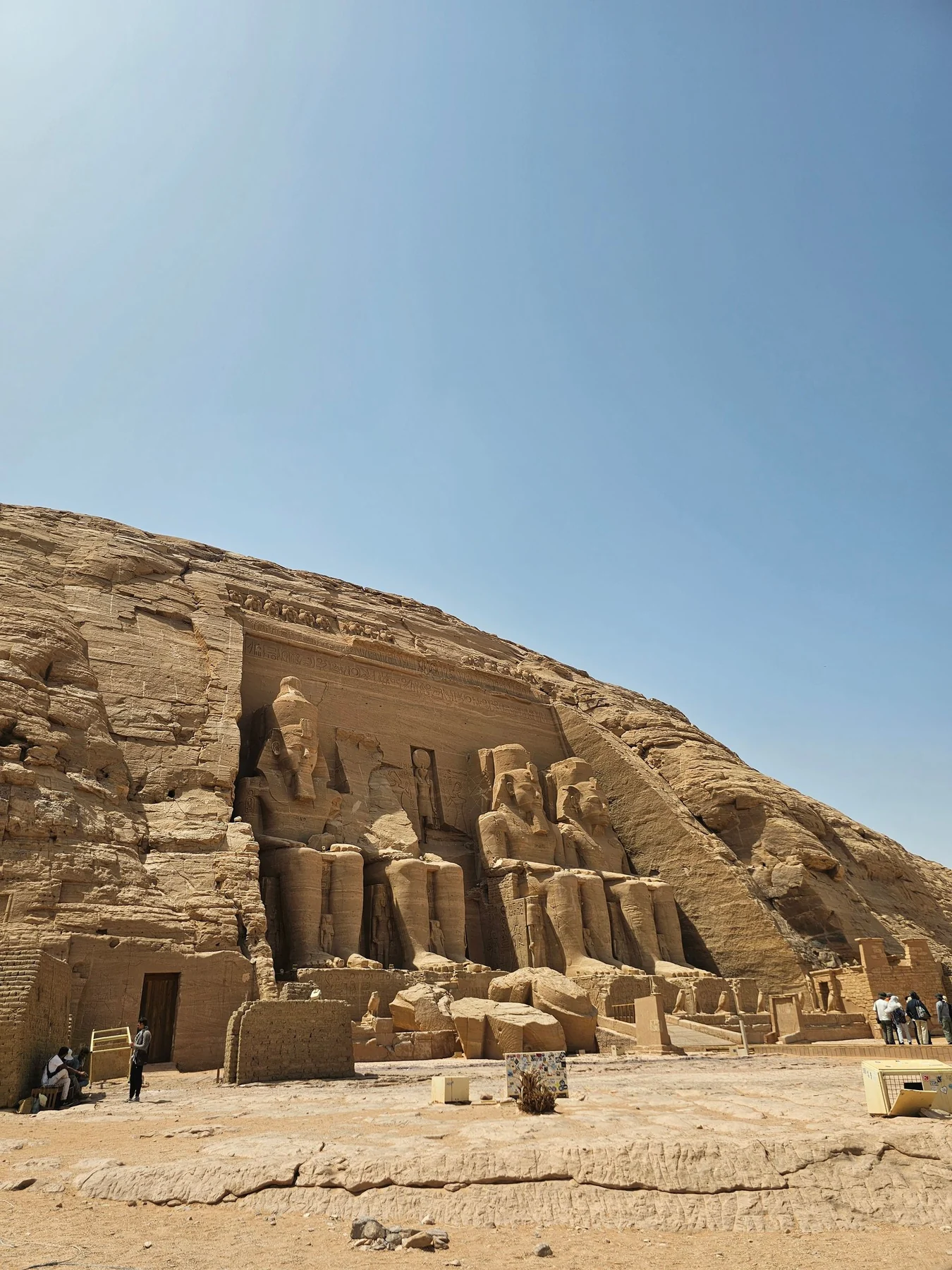
Toward dusk, once the day visitors have gone back to Aswan, walk down the sandstone cutting to Abu Simbel. The four colossi of Ramesses II emerge from the cliff in blue light, staring across the silence of the water.

You are met there by an engineer whose father worked the salvage. Between 1964 and 1968 the mountain was cut into one thousand and thirty-six blocks, lifted, and rebuilt sixty-five metres higher inside an artificial hill of concrete. He will show you the seams if you know where to look, and describe the arithmetic of moving a mountain by hand — the sawing, the numbering, the tolerances his father's crew worked to in the heat.

The Experience · The Temples at Dusk

The site after the day travellers leave — through the great portal into the hypostyle hall, eight pillars of the king leading into the dark of a mountain that was cut apart and reassembled by hand within living memory.

Tonight · Seti Abu Simbel Lake Resort

The Temple of Isis at Philae rising from Agilkia Island beside the Nile
The colossal seated figures of Ramesses II carved into the Great Temple at Abu Simbel

Day 05 · Abu Simbel to Luxor

The Sun at the Threshold

Abu Simbel & Luxor

“The sun measures the stone; the river measures everything else.”

Before dawn the desert air is still cold. You stand before the Great Temple as the first light breaks over the eastern horizon and travels the length of the rock-cut corridor to the sanctuary deep inside the mountain — an alignment calculated more than three thousand years ago, and reproduced, one day late, by twentieth-century engineers who could not quite match it.

A short flight carries you north to Luxor, the ancient capital of Thebes. Settle into the Winter Palace on the east bank, where nineteenth-century verandas overlook the river and the palms beyond.

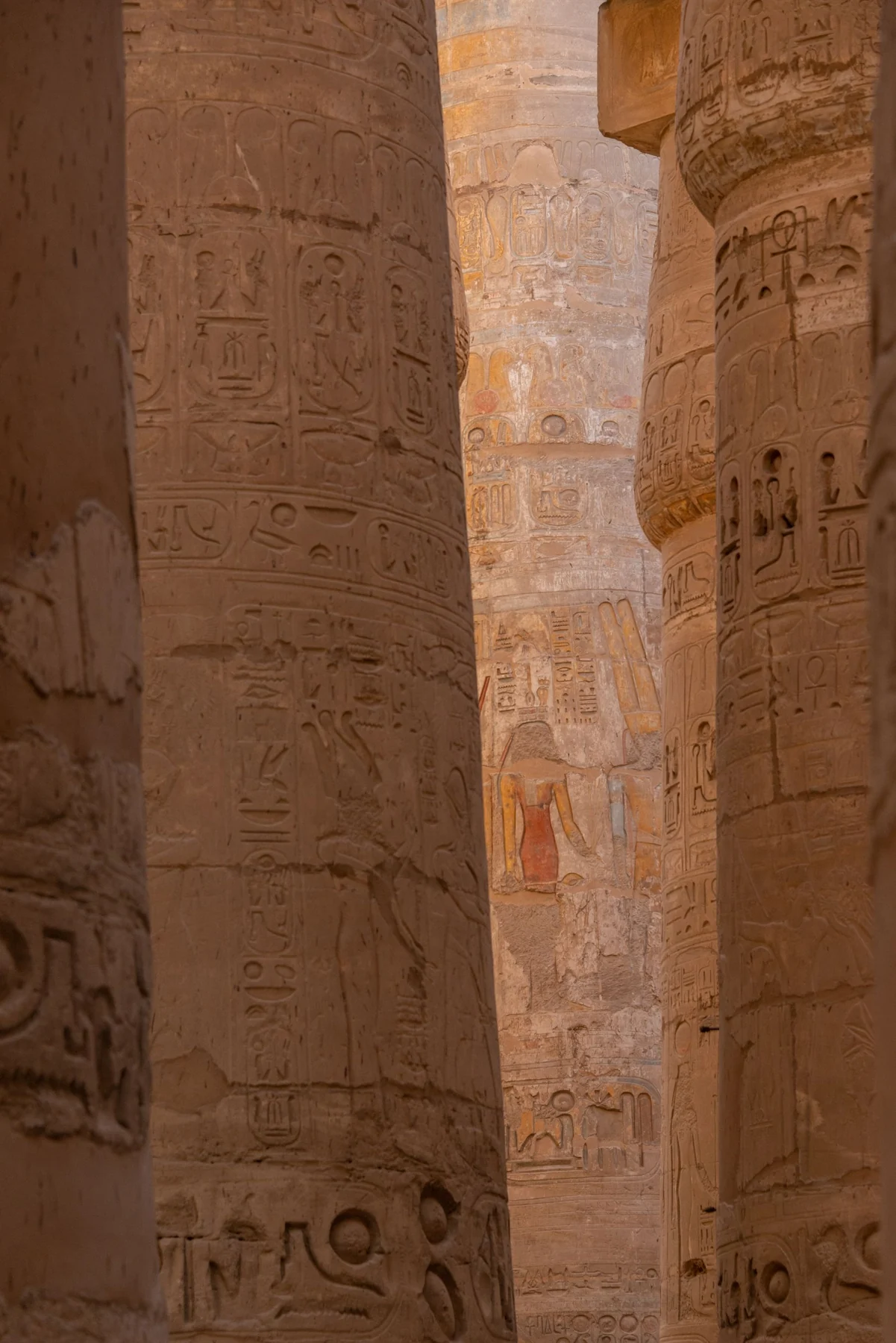
After nightfall the gates of Karnak are opened. You walk the Great Hypostyle Hall in silence between one hundred and thirty-four sandstone columns under an open desert sky.

You are not walking it alone. A scholar of Egyptian religion walks with you and describes what the building was for: a machine for feeding a god, staffed at its height by tens of thousands, its inner rooms entered by almost no one. Priestly cosmology, the daily ritual of waking and dressing the statue, the offering tables, the political economy of divinity. By the time you reach the sacred lake, the columns have stopped being architecture.

The Night at Karnak

The great stone forest after closing — no crowd, no perimeter lamps — walked with a historian of Egyptian ritual who can say precisely what happened in each court, and who was forbidden to enter it.

Tonight · Sofitel Winter Palace Luxor

The immense inscribed columns of Karnak’s Great Hypostyle Hall

Day 06 · Luxor West Bank

The Western Mountain

Theban Necropolis

“Three thousand years held in the dark.”

Cross the river before first light. Above the west bank the green ribbon gives way to dry limestone and silence as the sun strikes the Theban hills.

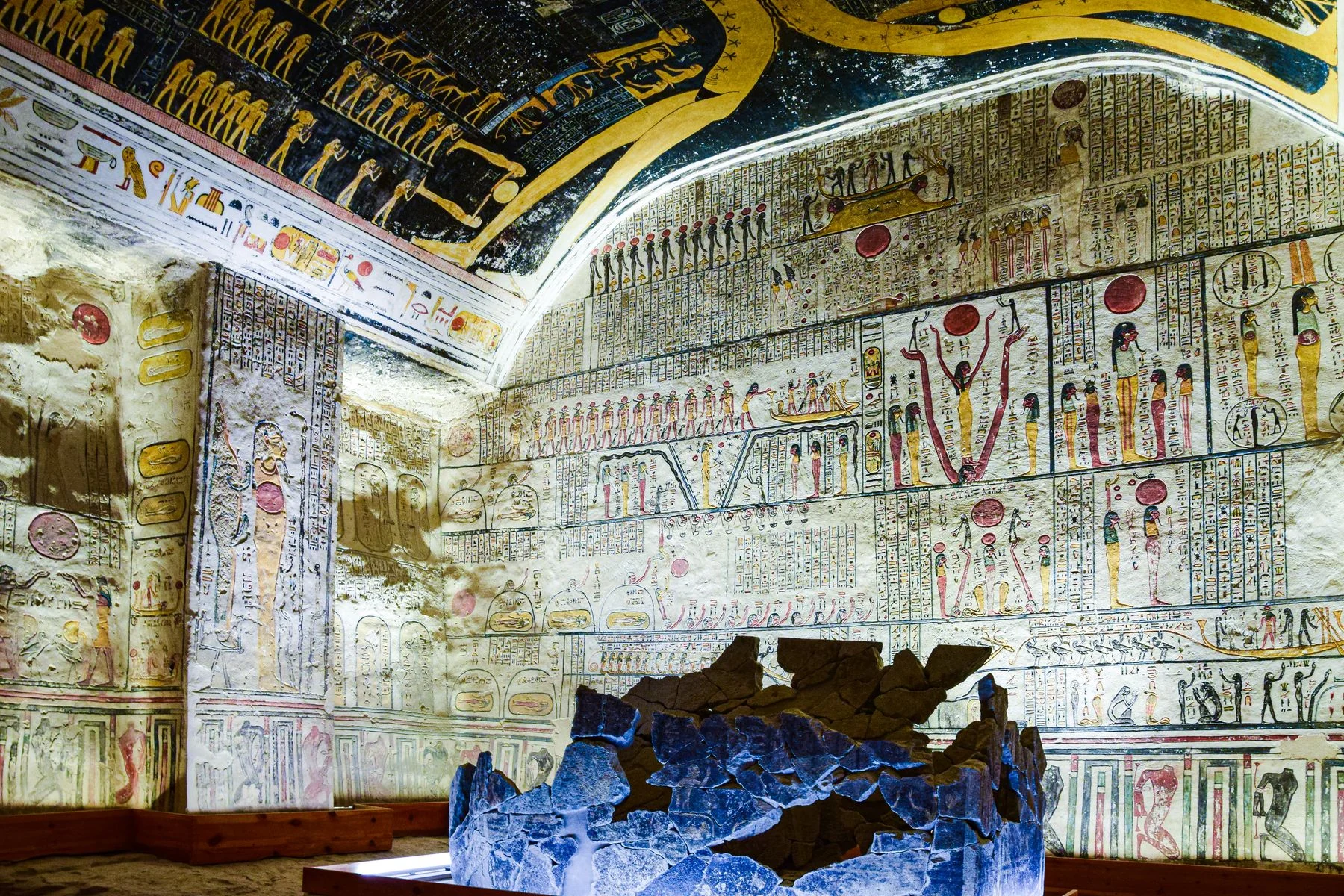
Descend into the Valley of the Kings. The subterranean chambers of Seti I and Ramesses VI are opened: corridors cut deep into bedrock, lapis and ochre and plaster still vivid beneath the rock.

You are taken down by the director of a current excavation in the valley, in the hour before his own team begins work. He will point out the ancient graffiti of the workmen, the abandoned corridor that goes nowhere, and the shaft he believes leads somewhere he is not yet ready to name in a journal.

Across the ridge, the terraced colonnade of Hatshepsut rises against the sheer cliff at Deir el-Bahari — a queen whose name was chiselled out of her own monuments by the man who came after her.

Return across the Nile in the afternoon, where the gardens of the palace offer shade until evening.

The Subterranean Chambers

Inside the burial hall of Seti I before the heat settles into the limestone, with the archaeologist whose concession lies a few hundred metres away and whose season depends on what the next wall gives up.

Tonight · Sofitel Winter Palace Luxor

The painted burial chamber of Ramesses VI in the Valley of the Kings

Day 07 · Luxor

The Court of Ramesses

The West Bank & Luxor East Bank

“The reliefs were cut deep enough that the desert could never smooth them away.”

Cross the river early for Medinet Habu. The mortuary temple of Ramesses III carries reliefs cut unusually deep into the sandstone — deliberately, to withstand defacement and the scouring of the wind. High in the lintels, original blue and ochre still catch the morning light. A stone carver joins you in the shade of the first court with his tools: copper, sand, a wooden mallet, and the same abrasive logic used to cut the wall above you. He is the fourth generation of his family in the trade, and the last, because his sons have gone into the hotels. He says this without complaint. Ask him anyway who takes it after him.

By midday, cross to a family house near Qurna. For two centuries these families lived on the hillside above the necropolis, and the old men still describe the tombs the way other people describe their childhood streets — which doorway let the light in, which shaft the dogs would not enter, whose grandfather guided which foreign expedition. The photographs come out. The arguments are about who remembers correctly. Lunch is long and unhurried, kept clear of the heat.

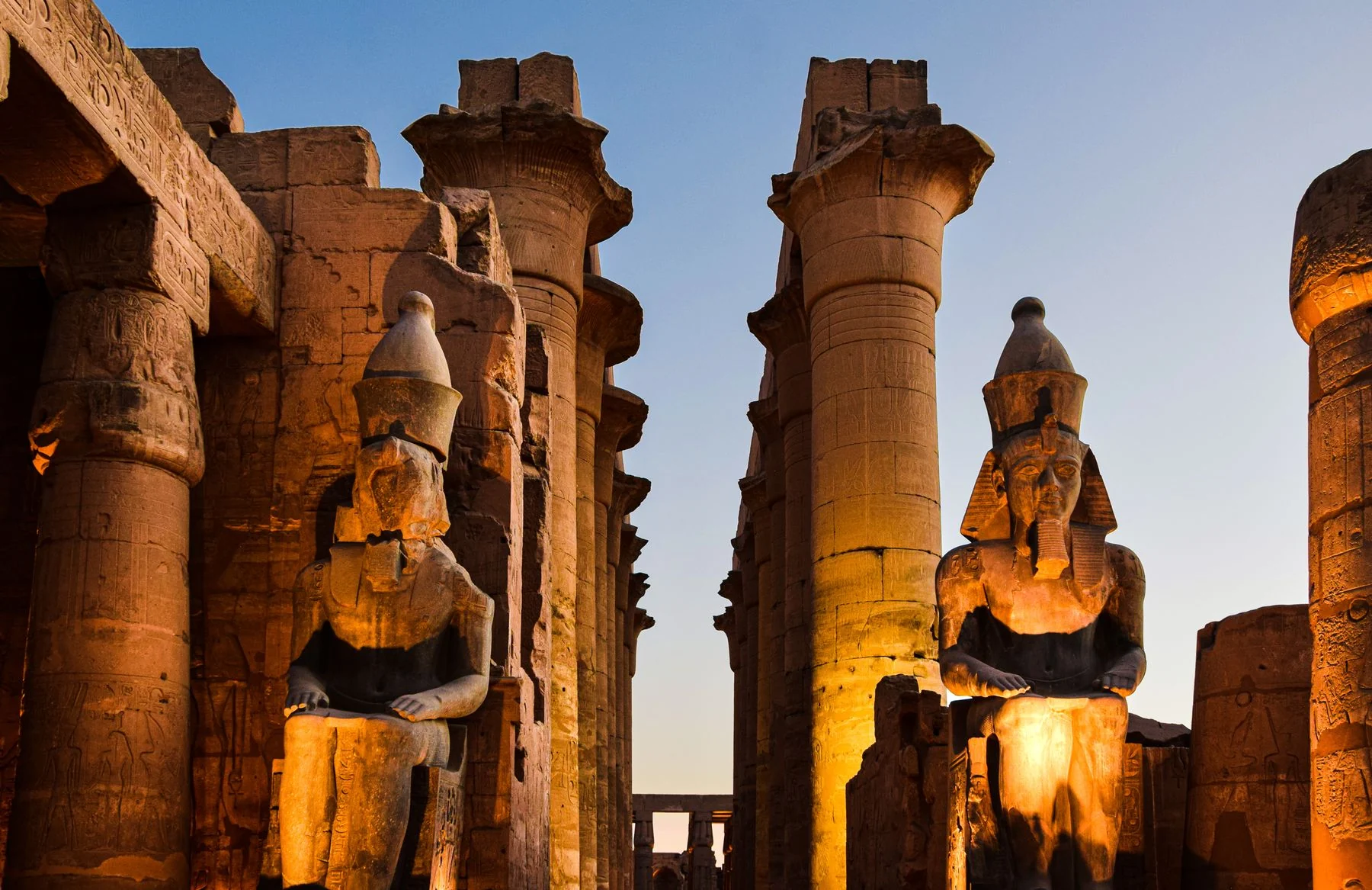
Return to the gardens of the Winter Palace in the afternoon. Rest under the bougainvillea, let the hours pass on the veranda, then cross back to the east bank as the light turns amber. At dusk you enter Luxor Temple: the papyrus columns of Amenhotep III catch the last sun, and the Avenue of Sphinxes falls into shadow. A final dinner is laid at the riverbank, unhurried, as the current moves past in the dark.

The Hillside Table

A private lunch with a Qurna family who lived for generations above the necropolis, followed by an evening entry into Luxor Temple and a final dinner at the river's edge.

Tonight · Sofitel Winter Palace Luxor

Colossal statues and illuminated columns at Luxor Temple as evening falls

Day 08 · Luxor & Cairo

The Northern Return

Luxor & Cairo

“The river always runs north.”

The morning begins quietly along the water. Across the Nile the pale limestone of the Theban hills catches the earliest light — the same dry silence that has held over the necropolis for millennia.

A final breakfast overlooking the palms on the eastern bank.

Then north to Cairo, tracing the thin ribbon of green silt that separates the eastern and western deserts. Arrive in the capital in time for your onward connection.

Egypt, from here, does not close. The excavation director's season runs to March, and he will write when the wall is clear. The conservator has promised photographs of the joint, stabilised or lost. The house on Elephantine expects you to come back with the rest of the family.

The river always runs north. The correspondence continues.

Afterwards

The introductions are not closed at the airport. Where the guest wishes it, we keep the correspondence open with the scholars, conservators and families met along the river.

A felucca crossing the Nile at sunset on the final morning in Luxor

The River Remembers

Five thousand years, and the stone is still giving up its argument.

  • 8 days · 7 nights
  • Cairo · Aswan · Abu Simbel · Luxor
  • Private aviation · River craft · Temple access after dark

Enquire

Begin this journey

This itinerary is a starting point, not a product. Tell us your dates and we will rewrite it around your family.